
Published on March 26, 2026 • Reading time: 4 minutes • By James Hartley
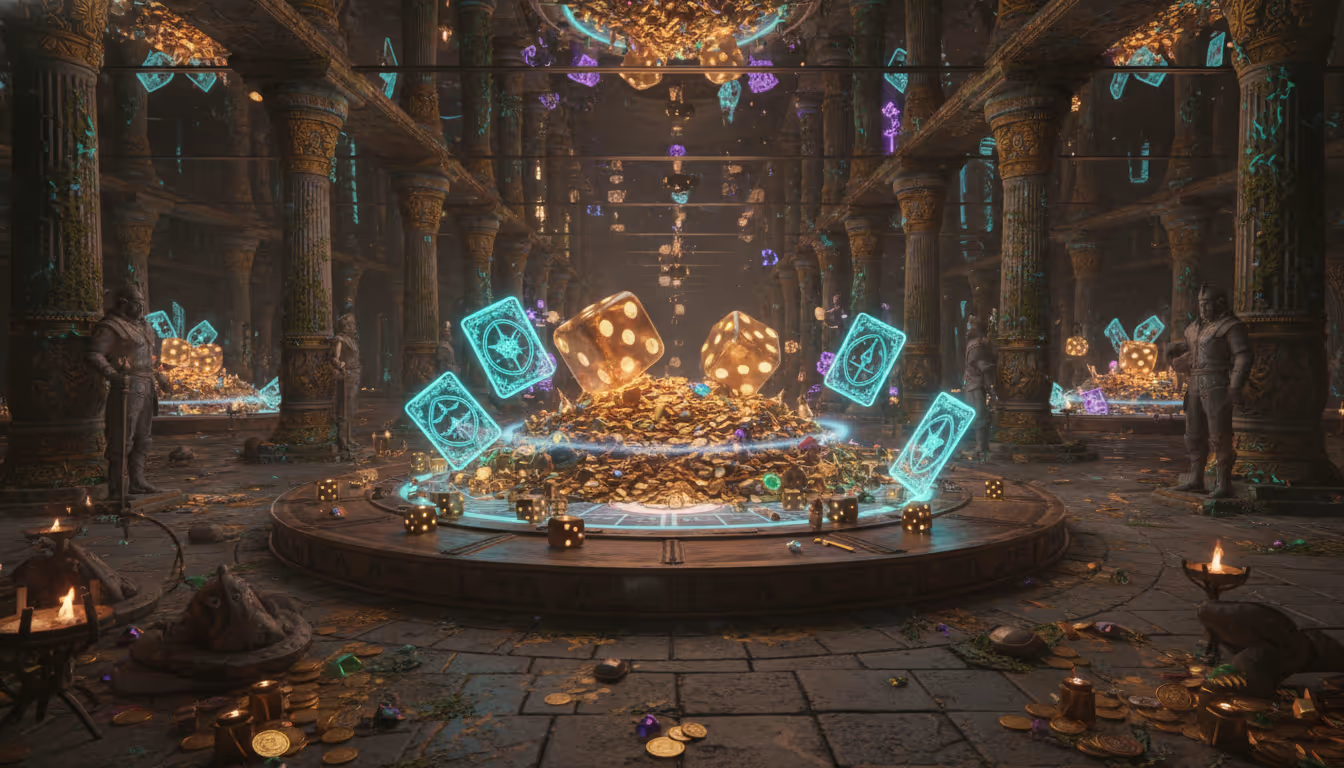
Gambling produces superstition more reliably than almost any other activity, and it does so in every culture that has ever gambled. The habits themselves are worth knowing — most have a traceable history and a specific meaning — and so is the reason they cluster around games of chance in the first place.
Five that travelled
- Salt over the left shoulder — European, and older than casinos. Salt was valuable enough that spilling it counted as a small disaster; the throw over the left shoulder was aimed at the devil, who was held to stand there.
- The beckoning cat — maneki-neko, Japanese, popularised in the Edo period. The raised paw is a beckoning gesture: a raised left paw is said to invite customers, a raised right paw to invite money. Which paw matters is a detail most non-Japanese versions get wrong.
- The cornicello — the small Italian horn charm, worn against the malocchio, the evil eye. Its shape descends from horned amulets that predate Rome.
- The figa — a fist with the thumb between the first two fingers, known in ancient Rome as the mano fico and still carved as a charm in Brazil and Portugal.
- Turmeric — auspicious in Hindu ritual for reasons that long predate any card table, and carried into gambling as one more context where people want an auspicious start.
There are dozens more with the same structure. In much of East Asia the number four is avoided because it is a near-homophone for death, and red is favoured as the colour of good fortune. In American casinos players blow on dice before a roll. None of these is silly; all of them are old, and most began somewhere other than a gambling floor. It is worth reading alongside AI, VR and Live Studios: What Is Actually Changing in Online Casinos.
Why uncertainty produces ritual
The classic observation belongs to the anthropologist Bronisław Malinowski, who noticed that Trobriand islanders fishing in the safe inner lagoon used almost no ritual, while the same people fishing in the open sea — dangerous and unpredictable — used a great deal of it. The variable was not the importance of the catch. It was how much of the outcome lay outside their control.
A casino is an environment engineered to sit entirely outside a player’s control, which makes it close to ideal conditions for the same response. That is why the rituals are so widespread, and it is also the clearest evidence that they are about the person and not about the game.
| Ritual | Origin | Effect on the game |
|---|---|---|
| Salt over the shoulder | European folk belief | None |
| Maneki-neko | Edo-period Japan | None |
| Cornicello | Pre-Roman Italy | None |
| Figa | Ancient Mediterranean | None |
| Avoiding the number four | East Asian homophone | None |
| Blowing on dice | American craps tables | None |
The honest part
None of it changes an outcome. A certified random number generator keeps no record of previous rounds and has no way of registering what you did before pressing the button; a roulette wheel is indifferent to what is in your pocket. A ritual is a way of managing the feeling of uncertainty, and as long as that is all it is, it costs nothing. A related case is examined in The Dopamine Code: What Anticipation Does During a Spin.
Ritual clusters wherever outcomes are out of human hands. That is a fact about people, not a fact about the machine.
Where a harmless habit stops being harmless
There is one point at which it turns. A ritual becomes expensive when it starts supplying a reason to keep playing — when the thought is that the charm has not worked yet, so the session cannot end yet. That is the gambler’s fallacy wearing a costume, and it is the only version of superstition with a price attached.
- Keep the ritual and keep the limit; the limit is the part that does something.
- Notice if a ritual is being used to justify one more deposit rather than to mark the start of a session.
- Treat a charm as part of the entertainment, which is what the budget is buying.
Questions players ask
Do any casino rituals improve your odds?
No. Certified games draw each round independently, and nothing outside the game is an input to that draw.
Why are gambling superstitions so common?
Because ritual reliably appears where outcomes are uncontrollable, a pattern documented across many cultures. A casino is an unusually pure example of an uncontrollable environment. The mechanics behind that are set out in Hidden Gems: How to Judge a Slot You Have Never Heard Of.
Is there any harm in having a lucky charm?
Not in itself. It becomes a problem only when it starts to justify continuing a session — the belief that the charm has not paid off yet is the gambler’s fallacy in another form.